
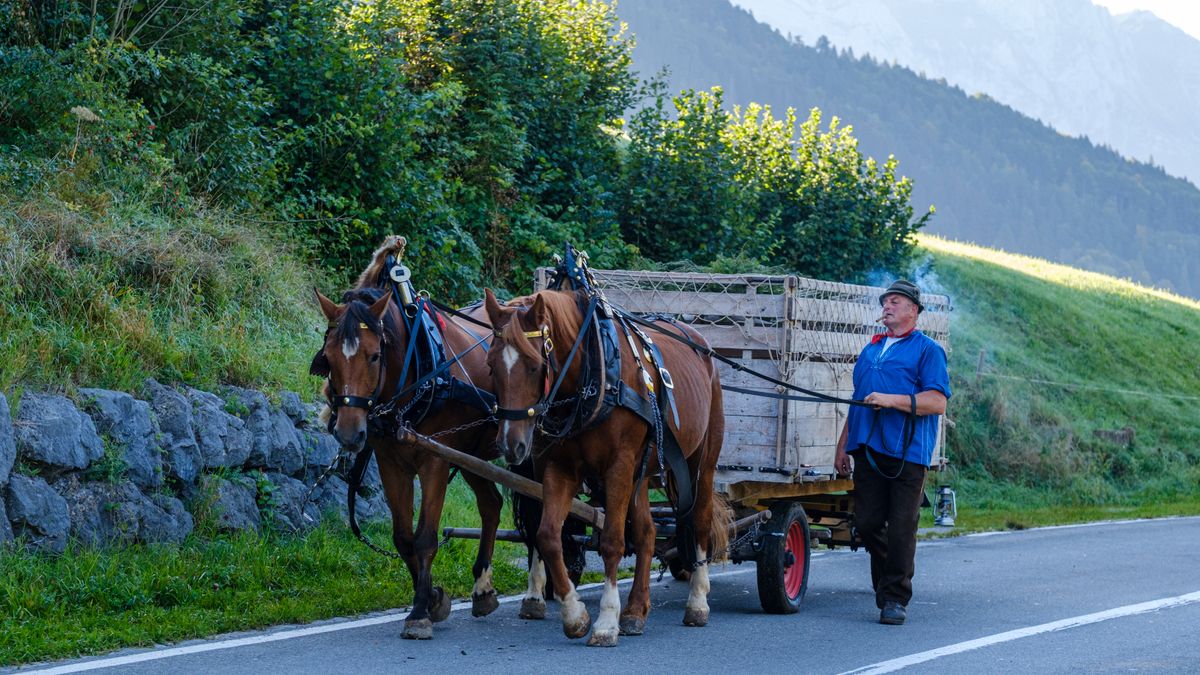
A carriage horse's requirement changes with every week of the season. A quiet fortnight of schooling and short hacks asks far less than six days of driving at a county show, a marathon phase, or a long cross-country route with a heavy vehicle behind. Before you change anything in the bucket, work out what the horse is actually doing: hours in harness, pace, terrain, the weight of the carriage and the number of passengers aboard. Cold, wet and windy weather adds its own demand, and a clipped horse turned out in a February field will burn more energy simply staying warm than many owners expect.
Feed the horse in front of you rather than the type of horse you think you own. Two animals of similar build in the same yard can need very different rations, and the one that looks well on a handful of fibre may be working twice as hard as the one on a full feed bowl.
However busy the calendar gets, forage should supply the bulk of the ration. Aim for a minimum of 1.5 per cent of bodyweight in dry matter each day, and closer to 2 per cent where possible. For a 500 kg horse that is a good 10 kg or more of hay or haylage, ideally split between several nets so the gut is never empty for long.
Quality matters as much as quantity. Late-cut meadow hay is a sensible base for horses that fizz up easily, while a slightly richer haylage or a portion of alfalfa can suit those in hard work who struggle to hold condition. Soaking hay reduces dust and, for a short period, some water-soluble sugars — useful if you are managing a horse prone to excitable behaviour.
Weigh your nets. A haynet that "looks about right" can vary by two or three kilos, and that is the difference between holding condition and losing it over a busy month.
When forage alone will not meet the demand, top up with energy from fibre and oil wherever you can, and treat starch as a tool rather than a default.
Keep individual meals modest — no more than about 2 kg of concentrate per feed for a 500 kg horse, with the total split across three or four smaller feeds rather than two large ones.
High-starch diets and excitable temperaments are a poor combination in harness, where a moment of silliness can unsettle a carriage. If a horse is sharp, look first at the total starch and sugar in the ration, including molasses in mixes and sugary treats. Reducing starch offers a good start. Increase oil and digestible fibre, increase turnout and slow, steady work, and keep the daily routine as consistent as possible.
Avoid drastic cuts the day before a show — an empty, anxious horse is no calmer than a well-fed one. Steady management over weeks does far more than any last-minute adjustment.
Clean water available at all times is non-negotiable, and a working horse will drink considerably more than a resting one. Provide a salt source daily, roughly 25 to 50 g of plain salt in the feed for a horse in regular work, so the horse can replace what it loses in sweat.
After heavy sweating — a long marathon phase, a hot show day, or a journey in a warm lorry — a proper electrolyte supplement helps restore sodium, chloride, potassium and magnesium. Offer it in water the horse will actually drink, and check for dehydration by pinching the skin on the shoulder for a second or two and watching how quickly it settles.
Body condition scoring is the most reliable guide you have. On a scale of 0 to 5, aim for 2.5 to 3: ribs easily felt but not seen, a level back, and no hard crest along the neck. Combine this with a weigh tape every fortnight and note the results, along with appetite, droppings and coat shine.
Change the ration in small steps, around 10 per cent at a time, allowing a week or two for the horse to adjust. Get it right and the reward is a carriage horse that pulls strongly through a long day, recovers quickly, and still stands quietly in the traces at the end of it.

Hi, my name is Anthony kuber. I am artist and fashion designer.
I love to travel and writing blogging.
Your email address will not be published. Required fields are marked *
Software Developer & Writer
Hey, I'm Diva, a developer and writer blending code and creativity. I'm driven by a deep curiosity and a relentless pursuit of excellence. Join me as I craft digital solutions and captivating stories.


